Endolinguistics and language
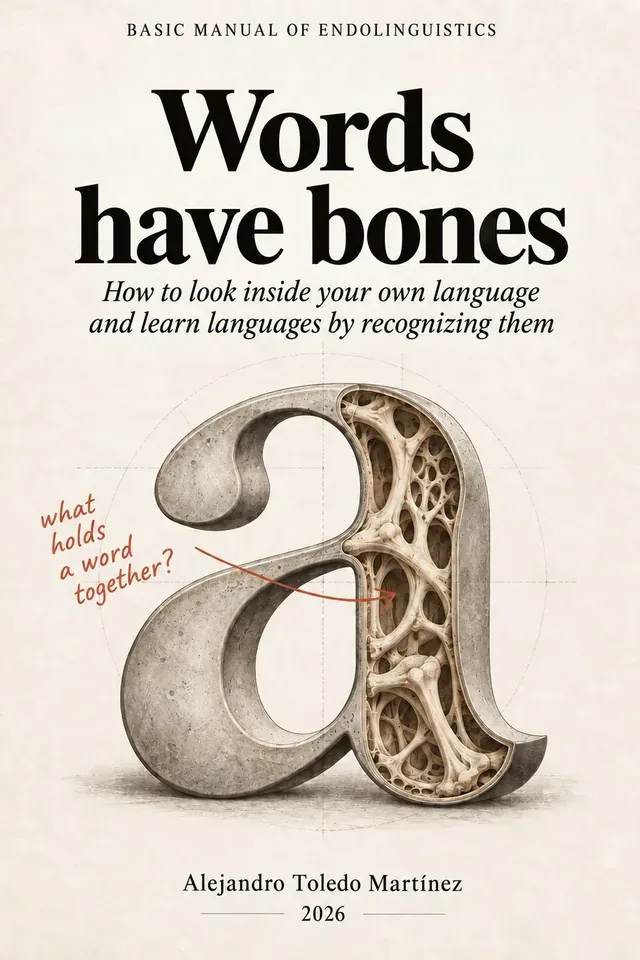
Words have bones
How to look inside your own language and learn languages by recognizing them
A basic manual of endolinguistics: how to look inside your own language and learn languages by recognizing them. Free.
About this book
This manual was born from a question young readers often ask: what is endolinguistics good for? The short answer: for looking at words from the inside. Whoever learns to do it stops learning languages like someone carrying stones one at a time, and starts recognizing them.
In four parts, with explanations, examples, exercises and challenges, you learn to pull out the consonant skeleton of a word and to recognize the seven families of sounds (the OAS classes); to tell true relatives from deceptive look-alikes, and to follow the rules by which words change from one language to another, with a step-by-step study method; to hear what vowels, rhythm and stress say; and to think carefully, so you do not fool yourself.
You do not need to know linguistics or Latin: your own language and the wish to look are enough. Written above all for young people who are learning a language, who enjoy puzzles and codes, or who wonder how the mind works. Includes a quick-reference table, solutions, a glossary and further reading. Free.
Book details
- Author
- Alejandro Toledo Martínez
- Language
- English
- Format
- Collection
- Endolinguistics and language
This work in other languages
Alejandro Toledo Martínez
Endolinguistics researcher and author
About the author →Continue reading
Theory of Endolinguistics
Foundations and applications of endolinguistics: the study of the deep structures of language beneath its observable surface.
Psychophonology
How thought becomes sound: language as a psychic, logical and musical system of sound relations. Phonology kept the half you can count; this book recovers the other.
Theory of the Topology of the Qualic Field
Some words are not related, and yet they meet. Drawing on nearly 4 million words from 3,405 languages, this book asks where, how and why.